Virtual Rounds Session 5: Thyroid Disorders (Premed Shadowing)
2 min read
Skip To:
Throughout each premed virtual shadowing session, you will actively participate by answering and asking questions about the week’s proposed case. Like an in-person shadowing experience, we strive to stimulate students intellectually and ultimately reaffirm their interest in medicine.
Introduction – Thyroid Disorders
The thyroid is essential to the metabolic functions of a multitude of organs in the body. Besides thyroid cancer, there are two primary classifications for thyroid disorders: hypothyroidism and hyperthyroidism.
Case Highlights
A 35 y/o F attorney presents to the clinic with worsening fatigue. She notes that for the past 2 months she has been experiencing lingering tiredness despite sleeping 8+ hours per night. She denies depression and states “I am too busy for that” but does report constipation, hair loss, and a 10-lb weight gain over two months despite not feeling very hungry. She notes at the firm, most of her co-workers are hot while she is bundled up with “as many clothes as I can find.” Her last normal period was “normal,” though she does admit there was a heavier flow than usual. She states previously she felt very well with a lot of energy but recently had “a cold and felt terrible” following this. No significant PMH.
Pathology
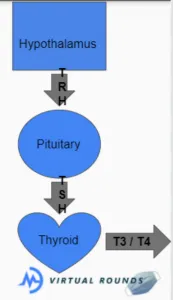
Above: Hypothalamic-pituitary axis
There are primarily two ways to classify thyroid disorders:
- Hypothyroidism
- Insufficient production of thyroid hormone
- Ex. Hashimoto’s thyroiditis
- Symptoms include:
- Weight gain
- Cold intolerance
- Fatigue
- Bradycardia
- Constipation
- Weakness/fatigue
- Hair loss
- Menstrual irregularities
- Edema
- Insufficient production of thyroid hormone
- Hyperthyroidism
- Increased or excess production of thyroid hormone
- Ex. Grave’s disease
- Symptoms include:
- Weight loss
- Heat intolerance
- Anxiety /insomnia
- Palpitations / tachycardia
- Diarrhea
- Weakness / myopathy
- Menstrual abnormalities
- Increased or excess production of thyroid hormone
In terms of risk factors, etiologies, or exposures of which place one at risk for developing a thyroid disorder, we might consider the following:
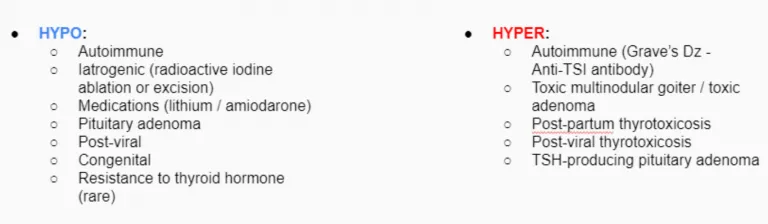
To diagnose thyroid disorders, the gold standard test is the TSH. The TSH value in combination with the Free T3/T4 can point us in the direction of whether we are dealing with a hypothyroid or hyperthyroid state.
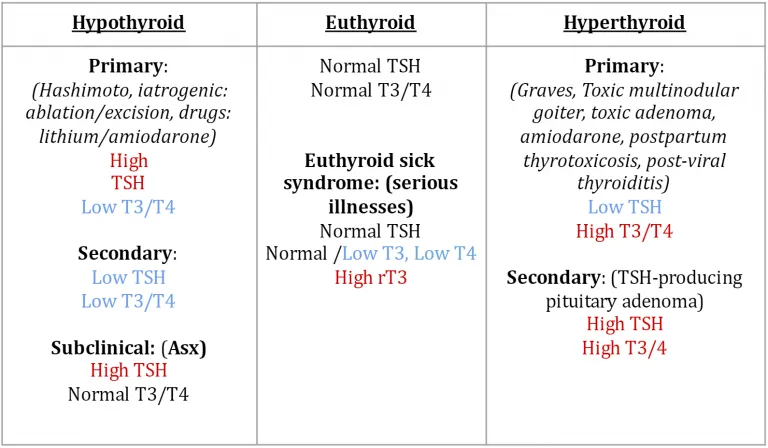
Treatment is directed towards whether we are dealing with hypothyroid or hyperthyroid state:
- Hypothyroidism:
- Levothyroxine / synthroid (thyroid hormone supplementation)
- Hyperthyroidism:
- Radioactive Iodine Ablation / Surgical excision (definitive treatment)
THEN
- Levothyroxine / synthroid (thyroid hormone supplementation)
- Propranolol (symptomatic relief)
Take home points
- Thyroid disorders are divided into hypothyroid and hyperthyroid.
- Hypothyroidism is insufficient thyroid hormone production while hyperthyroidism is excess or increased thyroid hormone production.
- Symptoms of hypothyroidism are consistent with slowing of metabolic function. Hyperthyroidism is reflective of increased metabolic function.
- TSH is the gold standard test for diagnosing thyroid disorders.
- Treatment is directed at either supplementing thyroid hormone of which is missing (levothyroxine, synthroid) or eliminating the source of excess thyroid hormone (ablation/excision) and then supplementing thyroid hormone after (levothyroxine, synthroid).
Watch the virtual shadowing session here:
Fill out this form throughout the session:
Written by  Motivate MD