
Am I Ready to Apply to Medical School Next Cycle?
8 min read10 sections
In this article10
TL;DR
If you are asking, “am I ready to apply to medical school?”, look beyond whether you are technically eligible. Readiness means your academics, MCAT, experiences, letters, application story, school-list options, and available preparation time work together well enough for you to submit a thoughtful application. Waiting may be the stronger decision when an important weakness cannot realistically improve before the cycle. It is useful only when the extra time has a clear purpose.
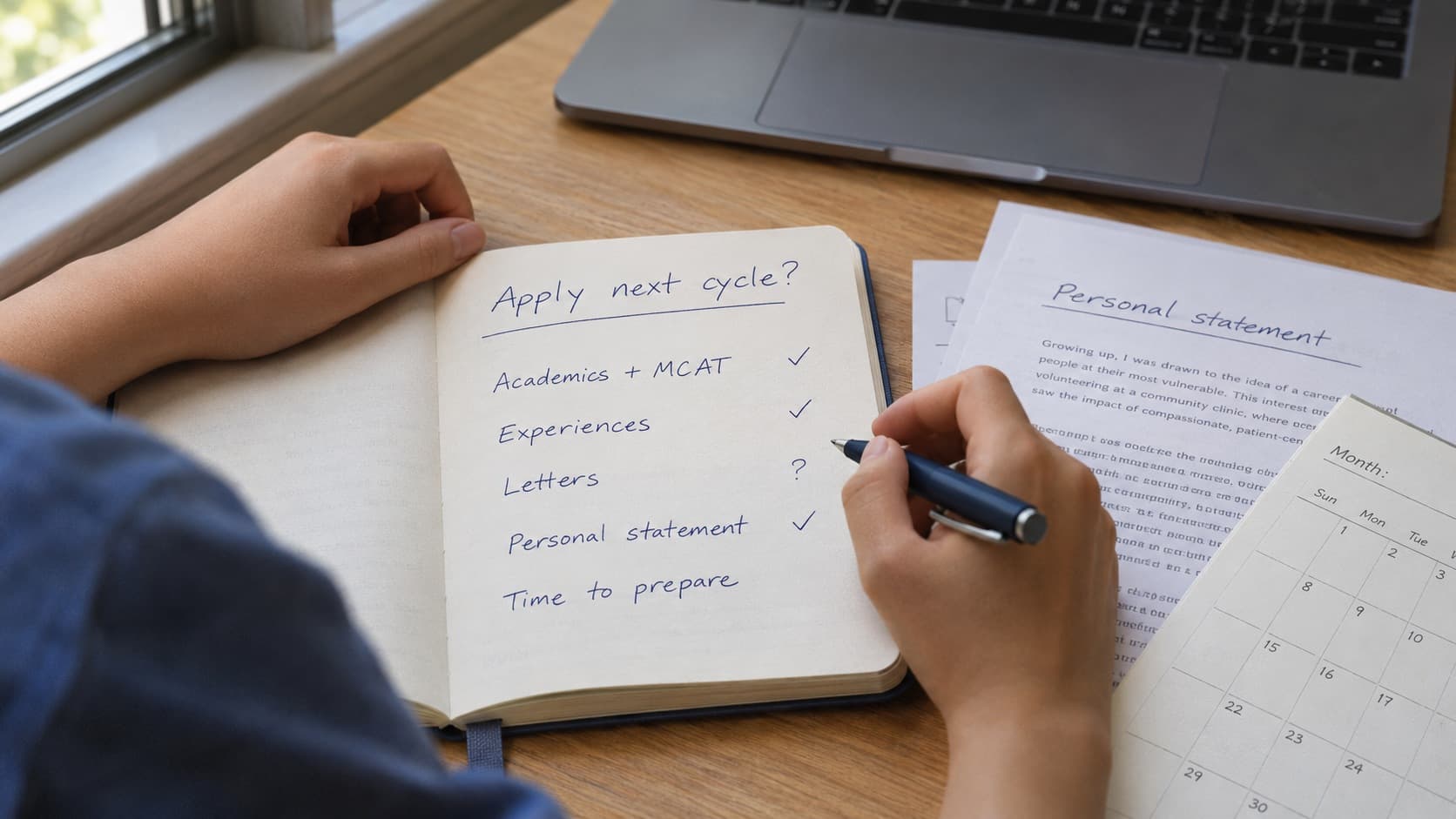
Deciding whether to apply to medical school next cycle can be harder than deciding whether you want to become a physician.
You may have completed the prerequisite courses, taken or scheduled the MCAT, and accumulated meaningful experiences. That can make you eligible to apply. It does not automatically mean this is the cycle in which you can present your strongest reasonable application.
The decision is not about reaching one universal GPA, MCAT score, hour count, or extracurricular profile. It is about whether the major pieces of your application are ready enough together, and whether waiting would materially change them.
Am I Ready to Apply to Medical School? Start With the Whole Application
A ready application is not a perfect application. Most applicants will have areas that are stronger than others.
What matters is whether the application gives admissions committees enough evidence to understand your academic preparation, commitment to medicine, service orientation, personal qualities, and reasons for pursuing this path. The AAMC’s Premed Competencies include professional, thinking and reasoning, and science competencies. They are a useful reminder that readiness extends beyond grades and test scores.
Medical schools also evaluate applicants in the context of their own missions and priorities. The AAMC describes mission-aligned selection as considering the broader combination of an applicant’s experiences, attributes, competencies, and metrics. That is why no single number or activity can answer the readiness question for everyone.
Motivate MD Insight: Separate eligibility from readiness. Eligibility asks whether you can submit an application. Readiness asks whether the application you could submit this cycle represents your preparation, experiences, and motivation clearly enough to justify the cost, time, and emotional energy of applying now.
Academics and the MCAT
Your academic record and MCAT help schools evaluate whether you are prepared for the demands of medical school. Readiness here is not determined by one universal cutoff.
Look at the full academic picture:
- Have you completed the prerequisite coursework required by the schools you may consider?
- Does your academic record show that you can manage challenging science coursework?
- If your earlier performance was weaker, is there enough recent evidence of improvement?
- Is your MCAT complete, or is there a realistic plan to take it without rushing preparation?
- Can you build a feasible school list from programs whose requirements and priorities fit your profile?
The AAMC’s Medical School Admission Requirements database allows applicants to compare information about U.S. and Canadian medical schools. Use school-specific information to evaluate feasibility rather than treating a national average as a universal admission line.
A concern may be manageable when the rest of your record provides context and evidence of readiness. A concern deserves more time when it reflects an unresolved academic pattern, an MCAT attempt for which you are not prepared, or a school list that would be unrealistic without meaningful improvement.
Experiences and Exposure
Your experiences should help you answer two different questions: Do you understand what you are choosing, and have you developed qualities that will help you serve others responsibly?
Clinical exposure matters because it gives you a more grounded view of patients, health care, and the physician’s role. Service matters because medicine is centered on responsibility to other people. Other experiences, including research, leadership, employment, teaching, or advocacy, can add important evidence depending on what you pursued and what the schools you are considering value.
Research is not a universal requirement for every applicant or every medical school. It becomes more important when it is central to your interests, your target programs, or the story you plan to present.
Ask whether your experiences have enough depth for you to discuss what you did, what you learned, and how your understanding changed. A long list of brief activities does not automatically make an application more ready than a smaller number of sustained, meaningful commitments.
Letters and Your Application Story
Strong application materials require more than assembling facts. Your letters and writing need to help another person understand how you work, what you value, and why medicine is the right direction for you.
For letters, consider whether you have recommenders who know you well enough to provide specific observations. Meeting a school’s letter requirement is important, but a letter is more useful when the writer can describe your contributions, growth, reliability, or readiness with real detail.
For your application story, ask whether you can explain:
- Why medicine makes sense based on what you have actually experienced
- Which experiences have most shaped your motivation and perspective
- What connects the different parts of your path
- What you want an admissions reader to understand beyond your metrics
You do not need a dramatic origin story. You do need enough reflection to write something more meaningful than a summary of your résumé.
Timing and Bandwidth
An applicant can have strong experiences and still be unprepared for the upcoming cycle because the application itself requires time.
Think honestly about the months ahead. Motivate MD’s Medical School Application Timeline can help you see when the major application stages arrive. Will you be preparing for the MCAT, completing demanding coursework, working significant hours, managing family responsibilities, or finishing a major commitment while also drafting the primary application and preparing for secondaries?
Readiness includes having enough bandwidth to present the work you have already done. If applying next cycle would force you to rush your personal statement, activities, letters, or school research, the problem may not be your underlying profile. It may be the quality of the application you would have time to produce.
This does not mean every component must be finished before the cycle begins. It means your plan should be realistic enough that important work receives thought rather than emergency attention.
What Can Realistically Improve Before the Cycle?
Not every concern requires delaying an application. The useful question is whether the concern can improve meaningfully in the time available.
- Can this concern improve before submission? A writing or organization problem may be addressable. A thin experience completed at the last minute may not gain meaningful depth.
- Would improvement be visible to schools? Planned growth is different from evidence already present when the application is reviewed.
- Would fixing it damage another part of the application? A rushed MCAT retake or overloaded schedule can weaken work that was already on track.
- Would an additional year materially change the evidence? Waiting is most useful when the extra time supports a specific academic, experiential, or personal improvement.
Be careful with vague plans such as “get more experience” or “make the application better.” Define what would be different, how you would create that change, and what evidence would exist by the following cycle.
When Waiting May Be the Stronger Decision
Waiting may be worth serious consideration when:
- Your academic readiness is still unclear and upcoming coursework could provide important evidence
- You would need to rush the MCAT or retake it without a meaningfully different preparation plan
- Your exposure to clinical settings or service is too limited for you to explain your decision with confidence
- You do not yet have appropriate letter writers who know your work well
- Your school-list options are extremely narrow or poorly aligned with your current profile
- Your available time would force you to rush the writing and research required for a thoughtful application
Waiting is not automatically the safer or better choice. An additional year does not strengthen an application by itself. It is valuable when you can name the weakness, choose a realistic response, and expect the resulting application to be materially different.
A Simple Medical School Application Readiness Check
Instead of assigning yourself a score, answer these questions in writing:
- What parts of my application are already strong enough to submit with confidence?
- What is the most important unresolved concern?
- Can that concern improve meaningfully before the upcoming cycle?
- Do I have enough time to prepare the application well without sacrificing other essential work?
- If I wait, what specifically will be stronger by the next cycle?
If your answers point to a feasible application, a coherent story, and enough time to execute well, applying next cycle may be reasonable. If one major weakness remains unresolved and an additional year would create clear evidence of improvement, waiting may be the more strategic choice.
If you want an outside assessment of how the pieces fit together, Motivate MD’s medical school admissions consulting can help you evaluate readiness and build a practical plan. The decision should still be grounded in your goals, evidence, and realistic options.
Choose the Cycle That Gives Your Application a Fair Chance
The question “am I ready to apply to medical school?” cannot be answered by one number or one activity. Readiness comes from the major pieces supporting one another and from having enough time to present them thoughtfully.
Applying next cycle may make sense if the application you can realistically submit will give schools a clear, credible picture of your preparation and motivation. Waiting may make sense if the additional time has a defined purpose and would produce a meaningfully stronger application.
The goal is not to apply as soon as possible or to delay until every concern disappears. It is to choose the cycle in which your application has a fair chance to represent the work you have done.
Frequently Asked Questions
How do I know if I am ready to apply to medical school?
Review whether your academics, MCAT, experiences, letters, application story, school-list options, and available preparation time work together well enough for a thoughtful application. You do not need a perfect profile, but major concerns should either be manageable now or supported by a realistic plan.
Do I need research before applying to medical school?
Research is not a universal requirement for every applicant or school. Its importance depends on your interests, target programs, and the role research plays in your application. Clinical exposure and service should not be replaced by research simply to add another category.
Should I apply if my MCAT score is still pending?
A pending score does not automatically mean you should wait a cycle. Consider when the score will arrive, how much it could change your school-list or retake decisions, and whether the rest of your application is ready. Avoid treating a hoped-for score as guaranteed.
Is taking a gap year better for medical school admissions?
Not automatically. Additional time is useful when it supports a specific improvement, such as stronger academic evidence, deeper clinical or service experience, a better-prepared MCAT attempt, or more thoughtful application materials. Delay without a clear purpose may not materially change the application.
What if I am ready in most areas but weak in one?
Consider how important that area is, whether the weakness affects your ability to demonstrate readiness for medicine, and whether it can improve before submission. One imperfect area does not always require waiting, but a major unresolved weakness may justify another cycle of preparation.
Published