
Secondary Application Timeline
7 min read7 sections
In this article7
Part 1: Secondary Application Timeline
Part 2: Strategies & Time Savers (with template included)
Part 3: Missed Deadlines

Part 1: Secondary Application Timeline
Now that your primary application has been submitted, when should you expect to receive a secondary application?
Most medical schools will begin sending secondary applications once an applicant’s American Medical College Application Service (AMCAS) primary application has been submitted and verified, which can take up to eight weeks from the time of submission. Therefore, applicants typically begin receiving secondary applications within eight weeks of their primary application submission. However, some medical schools do not wait for an applicant’s primary application to be verified and may send a secondary application prior to verification. In order to be as prepared as possible, applicants should be ready to begin secondaries as soon as their primary application is submitted.
Secondary Application Deadlines
The recommended turnaround time for secondary applications is no more than two weeks. However, actual deadlines for secondary applications, which are set by each school, are often not until several months after secondary applications are sent out. For more information on exact deadlines, Med School Insiders has created a helpful resource of Medical School Secondary Application Prompts by School/Program with Deadlines. So why should applicants aim to submit their secondary application months before the actual deadline? There are two main reasons why it is advantageous for applicants to get their secondary applications in early.
- Rolling Admissions Process: Most medical schools use a rolling admissions process to offer interviews and acceptances to their medical school. This means that admissions committees will begin reviewing applications for interviews as soon as they receive all of the application materials (primary application, secondary application, and MCAT score) for an applicant. The admissions committee will not begin reviewing the student’s application until all of these materials have been received. They will review applications in the order they receive them and offer interview invitations and acceptances accordingly. Therefore, an early secondary application submission means the admissions committee can begin their review of your application for an interview earlier in the application season.
- Submitting a secondary application early shows the school that you are interested: When you submit your secondary application within the recommended two-week time frame, it shows the school that you have prioritized your secondary application to their school. This can be advantageous to your application because admissions committees ideally would like to accept applicants who are highly interested in attending their school.
Although you want to turnaround secondaries promptly, do not sacrifice quality for speed. Taking a little extra time to write thoughtful, error-free responses will be a lot more advantageous than submitting a poorly-written response quickly.
Part 2: Strategies & Time Savers
Prioritize Schools
In order to optimize your strategy for tackling secondary applications, it is important to have a strategy. Once your primary application is submitted, I recommend going through the list of schools you applied to and creating a priority list. There are several different ways you can prioritize your list. Below are some examples of how you can prioritize your secondary applications.
- Example 1 (highest to lowest priority):
- Top Choices (include reach, target, and safety schools if possible)
- Remaining Target Schools
- Remaining Safety Schools
- Remaining Reach Schools
- Example 2 (highest to lowest priority):
- Top Choices
- Most Competitive Schools
- Less Competitive Schools
- Example 3 (highest to lowest priority):
- Top Choices
- Shortest Secondaries
- Longest Secondaries
Need help creating a prioritization list? Check out our Medical School Ranking Tool which helps you rank programs based on core criteria.
Pre-Write Secondary Essays
Once you have a list of which secondaries you plan to prioritize, you can begin to pre-write your essays. Many times, medical schools will reuse the same (or similar) prompts from previous years. Therefore, for your highest priority schools, you can look up their Secondary Essay Prompts from previous years and begin drafting responses while you wait for your primary application to be verified.
While pre-writing is an excellent technique for saving time (especially in the downtime while you are waiting for your application to be verified), it is important to note that it is not uncommon for medical schools to change their secondary essay prompt(s) from year to year. This, unfortunately, means that you may draft secondary responses to questions that are not used in this year’s secondary application. Fortunately, your time was most likely not wasted. Chances are, you will be able to incorporate many of the themes you wrote about in your draft on other secondary applications (even if the specific prompt you drafted a response for is not specifically asked). For tips on how to approach secondary applications, I recommend visiting these helpful links:
- Prewriting Secondary Applications
- 2026 Medical School Secondary Essays Examples
- Medical School Secondary Essays: Top Writing Tips
- Best Time Management Strategies for Secondary Applications
Stay Organized
Staying organized is going to be essential to your success in completing and submitting secondary applications promptly.
Check Your Email Regularly
Once your primary application is submitted, be diligent about checking the email that you listed on your application (at least daily). This is the main method of communication that admissions committees will be using to communicate with you, therefore, it is imperative that you check it frequently. Be sure to check both your main inbox AND your spam/junk folder, as sometimes secondary application invitations may be shuffled into these folders.
Pro tip: Some applicants find it helpful to create a new email for medical school applications. This can help to ensure that all emails related to your medical school application are separate from your personal emails.
Create a Spreadsheet
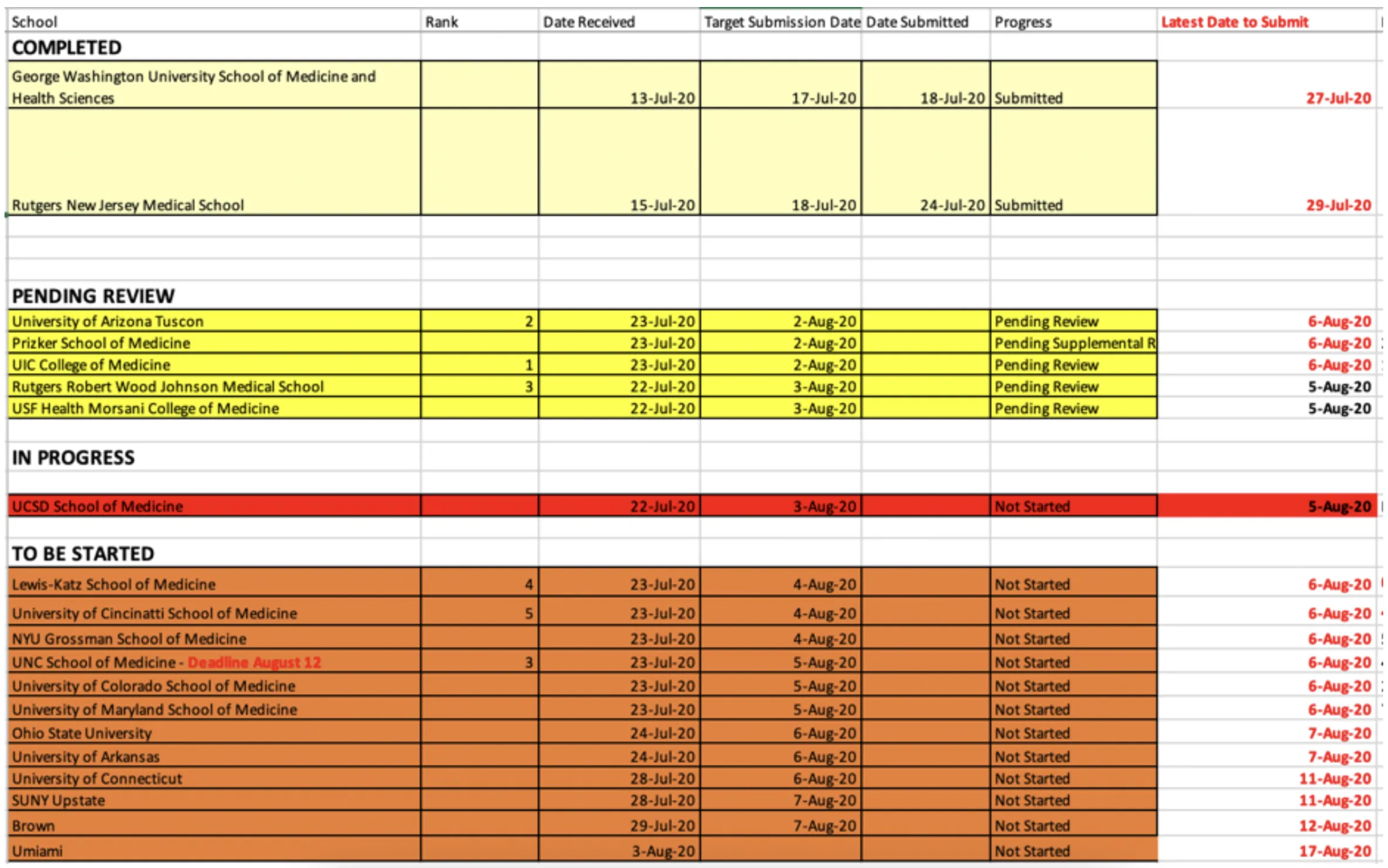
When secondaries start coming in, they often come in batches, which can be quite large depending on how many schools you applied to. Having a spreadsheet is an excellent way to stay organized and keep track of which schools have sent you a secondary application and which schools you are still waiting to hear from. This technique was essential to my success when applying to medical schools. I created a spreadsheet (pictured below) with seven columns:
- School Name
- Rank – (my personal ranking for prioritization purposes)
- Date Received – (date I received the secondary application invitation)
- Target Submission Date – (date I was aiming to submit the application, always no more than 2 weeks from the date I received it)
- Date Submitted – (filled in once my secondary was submitted)
- Progress – (Not Started/ In Progress/ Pending Review/ Complete)
- Latest Date of Submission (not pictured) – (this was the absolute last date that I wanted to submit my application NOT the deadline set by the school)

As I completed my secondary applications, I put them under the following headings: Completed, Pending Review, In Progress, and To Be Started. This was an excellent way to assess the status of each application while working on several applications simultaneously.
Click here to download a Free Secondary Application Spreadsheet Template.
Save Your Completed Applications
I cannot emphasize this enough! Save every completed secondary application. Many medical schools use very similar themes/ prompts. Sometimes, your response for one secondary prompt will answer the secondary prompts on several other applications. Therefore, having this information saved will save you lots of time and energy as you work through multiple applications.
Time-saving Tip
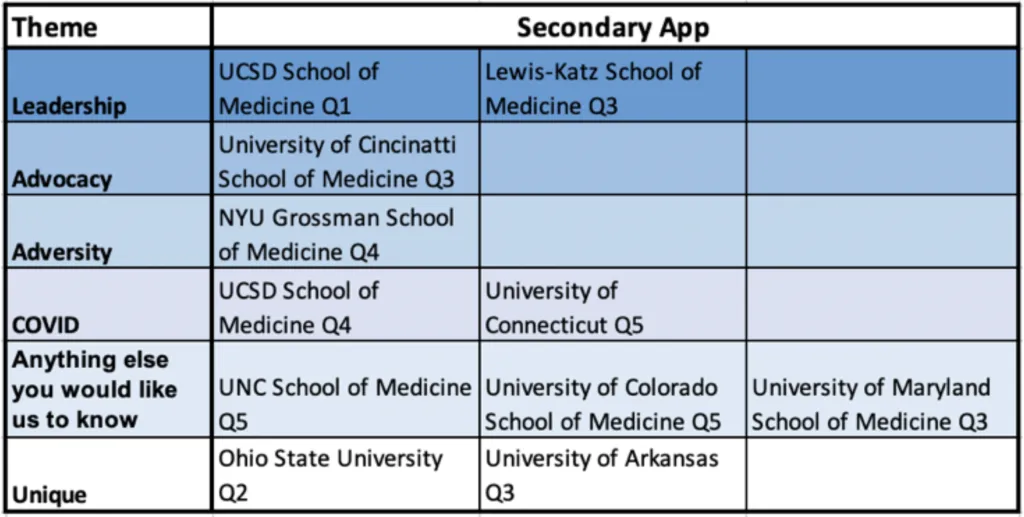
When working on multiple secondary applications, it can become hard to remember which prompts you have already written responses for. A great technique for this is keeping a spreadsheet (yes, another spreadsheet) of common themes that recur on secondaries and which secondary applications had those prompts. This helped me to avoid re-creating the same type of response over and over again. Instead, I used my previously submitted responses as a template for secondary applications with similar questions.
Need help writing your secondary essays?
Be Memorable. Claim an interview spot. Get Accepted.
Affordable Secondary Essay Editing | Click Here
Part 3: Missed Deadlines
With so much going on during application season, it is not uncommon to miss a secondary application invitation email or miss the recommended two-week turnaround time frame. No need to stress; it will be okay! Just because you submit a secondary application outside of the two-week recommended window does NOT mean that you won’t get an interview.
So, you missed the two-week time frame. What should you do next?
If it is just one secondary application, prioritize getting that application in ASAP, especially if it is for one of your top choice schools. Remember, don’t sacrifice quality for speed, but once you have written a quality, thoughtful response, get it submitted.
If you missed the recommended time frame for multiple secondary applications, try to prioritize the outstanding applications again. Which applications did you receive first? Out of those applications, which schools are among your top choices? I recommend completing applications for top choice schools that you received earliest first. You can then work your way through the other applications and submit them as soon as you can.
In summary, completing secondary applications can seem overwhelming and very time-consuming. However, going in with a strategy, prioritizing a list that is best suited for your needs, and staying organized can help you save time, stay on track, and meet the deadlines. Remember to give yourself grace during this time and recognize that every completed secondary application brings you one step closer to your goal!
Written By: Autumn M.

Autumn M.
Advisor · Editor · Interview Coach
Anesthesiology · Brigham & Women's Hospital
Rush Medical College of Rush University Medical Center
My name is Autumn and I am a first-year Anesthesiology Resident at Brigham & Women’s Hospital.
I joined Motivate MD in 2022 because I am passionate about mentoring and uplifting students as they apply to medical school and residency. My goal is to promote transparency around the application process by outlining expectations of what the process entails and creating realistic timelines that are catered to the unique needs of individual applicants. I aim to use my experiences to provide support to pre-medical and medical students, fostering hope and confidence as they pursue their journey towards becoming a physician.
Educational background: With an upbringing centered around service and a passion for working within marginalized communities, I was fortunate to embark on my undergraduate education at the University of Chicago, where I earned my Bachelor’s degree in Biological Sciences with a specialization in Endocrinology and a minor in Health and Society. My passion for advocacy and service led me to Rush Medical College. With a focus on utilizing education to promote empowerment, I had the opportunity to participate in positive change at Rush and lead efforts in implementing longitudinal initiatives within the community. Through these initiatives, I learned that I can use my platform to serve as an advocate and a leader and make impactful and sustainable change. I am inspired to continue rebuilding trust, reshaping patient perspectives, and re-writing the narrative that has been written for underserved patient populations.
- Let's stay in touch. Get the latest blog post in your inbox.
 Written By: Autumn M., MDPublished: